Compare
- Alloying route and key chemistry
- Particle-size distribution
- Apparent density and flow
- Compaction pressure and green density
 Luyin Powders
Request a Quote
Five alloy routes for powder metallurgy qualification: pre-alloyed, molybdenum-alloyed, free-cutting, phosphorus-alloyed and diffusion-alloyed. Compare fifteen specified grades, including separate specification and typical-value data for D3, D4 and D5. Actual batch results are provided in the shipment COA.
Confirm the series scope, controlled-document status, trial route and a comparable quotation basis.
Start with the technical series or current grade. Application suitability is confirmed only after chemistry, pressing conditions, particle profile and the controlled document set are reviewed together.
Compare all fifteen grades in the product specifications below. Typical values are labelled separately; actual batch results are provided in the shipment COA.
Fifteen grades across five alloy routes, with complete chemistry and physical specifications. D3, D4 and D5 include separate specification and typical-value rows. Check the 600 MPa or 490 MPa condition alongside every green-density value.
Product specification limits; actual batch results are provided in the shipment COA.
Chemistry and particle-size values are percentages. ≤ indicates a maximum; ≥ indicates a minimum. A dash or “Not stated” follows an unspecified source entry and does not mean zero. Select a grade to include it in your enquiry.
Scroll tables sideways to view all columns. The grade stays visible as you compare.
| Grade | C | Si | Mn | P | S |
|---|---|---|---|---|---|
| LAP100.29A1 | ≤0.01 | ≤0.05 | ≤0.15 | ≤0.020 | ≤0.015 |
| LAP100.29A2 | ≤0.01 | ≤0.05 | 0.20-0.50 | ≤0.020 | ≤0.015 |
| LAP100.29A3 | ≤0.01 | ≤0.05 | ≤0.15 | ≤0.020 | ≤0.015 |
| LAP100.29A4 | ≤0.01 | ≤0.05 | 0.35-0.55 | ≤0.020 | ≤0.015 |
| Grade | Cr | Ni | Mo | Co | Cu | HL (hydrogen loss) | TFe |
|---|---|---|---|---|---|---|---|
| LAP100.29A1 | - | 1.70-2.00 | 0.40-0.60 | - | - | ≤0.20 | Balance |
| LAP100.29A2 | 0.10-0.30 | 0.50-0.90 | 0.35-0.65 | 0.30-0.50 | ≤0.50 | ≤0.25 | Balance |
| LAP100.29A3 | - | 3.80-4.20 | 0.40-0.60 | - | - | - | Balance |
| LAP100.29A4 | - | 1.30-1.55 | 1.15-1.40 | - | - | ≤0.25 | Balance |
| Grade | Apparent density g/cm³ | Flow rate s/50 g | Green density g/cm³ · test pressure | Rattler value % |
|---|---|---|---|---|
| LAP100.29A1 | 2.90-3.15 | ≤28 | ≥6.90 at 600 MPa | ≤1 |
| LAP100.29A2 | 2.90-3.15 | ≤28 | ≥6.85 at 600 MPa | ≤1 |
| LAP100.29A3 | 2.90-3.15 | ≤28 | ≥6.75 at 600 MPa | ≤1 |
| LAP100.29A4 | 2.90-3.20 | ≤28 | ≥6.65 at 490 MPa | ≤1 |
| Grade | 180-200 μm | 150-180 μm | 45-150 μm | < 45 μm |
|---|---|---|---|---|
| LAP100.29A1 | ≤1 | ≤10 | Balance | 10 ~ 30 |
| LAP100.29A2 | ≤1 | ≤10 | Balance | 10 ~ 30 |
| LAP100.29A3 | ≤1 | ≤10 | Balance | 10 ~ 30 |
| LAP100.29A4 | ≤1 | ≤10 | Balance | 10 ~ 30 |
| Grade | C | Si | Mn | P | S |
|---|---|---|---|---|---|
| LAP100.29Mo1 | ≤0.01 | ≤0.05 | ≤0.15 | ≤0.020 | ≤0.015 |
| LAP100.29Mo2 | ≤0.01 | ≤0.05 | ≤0.15 | ≤0.020 | ≤0.015 |
| LAP100.29Mo3 | ≤0.01 | ≤0.05 | ≤0.15 | ≤0.020 | ≤0.015 |
| Grade | Cr | Ni | Mo | Co | Cu | HL (hydrogen loss) | TFe |
|---|---|---|---|---|---|---|---|
| LAP100.29Mo1 | - | - | 0.50-0.70 | - | - | - | Balance |
| LAP100.29Mo2 | - | - | 0.80-1.00 | - | - | - | Balance |
| LAP100.29Mo3 | - | - | 1.40-1.60 | - | - | - | Balance |
| Grade | Apparent density g/cm³ | Flow rate s/50 g | Green density g/cm³ · test pressure | Rattler value % |
|---|---|---|---|---|
| LAP100.29Mo1 | 2.90-3.15 | ≤28 | ≥7.00 at 600 MPa | ≤1 |
| LAP100.29Mo2 | 2.90-3.15 | ≤28 | ≥7.00 at 600 MPa | ≤1 |
| LAP100.29Mo3 | 2.90-3.15 | ≤28 | ≥7.00 at 600 MPa | ≤1 |
| Grade | 180-200 μm | 150-180 μm | 45-150 μm | < 45 μm |
|---|---|---|---|---|
| LAP100.29Mo1 | ≤1 | ≤10 | Balance | 10 ~ 30 |
| LAP100.29Mo2 | ≤1 | ≤10 | Balance | 10 ~ 30 |
| LAP100.29Mo3 | ≤1 | ≤10 | Balance | 10 ~ 30 |
| Grade | C | Si | Mn | P | S |
|---|---|---|---|---|---|
| LAP100.29S1 | ≤0.02 | ≤0.05 | 0.10-0.30 | ≤0.020 | 0.30-0.40 |
| LAP100.29S2 | ≤0.02 | ≤0.05 | 0.10-0.30 | ≤0.020 | 0.20-0.30 |
| Grade | Cr | Ni | Mo | Co | Cu | O (oxygen) | TFe |
|---|---|---|---|---|---|---|---|
| LAP100.29S1 | - | - | - | - | - | ≤0.25 | ≥99 |
| LAP100.29S2 | - | - | - | - | - | ≤0.25 | ≥99 |
O is oxygen content for these free-cutting grades; it is a different property from hydrogen loss (HL).
| Grade | Apparent density g/cm³ | Flow rate s/50 g | Green density g/cm³ · test pressure | Rattler value % |
|---|---|---|---|---|
| LAP100.29S1 | 2.90-3.10 | ≤30 | ≥6.70 at 490 MPa | - |
| LAP100.29S2 | 2.90-3.10 | ≤30 | ≥6.70 at 490 MPa | - |
| Grade | 180-200 μm | 150-180 μm | 45-150 μm | < 45 μm |
|---|---|---|---|---|
| LAP100.29S1 | ≤1 | ≤10 | Balance | 10 ~ 30 |
| LAP100.29S2 | ≤1 | ≤10 | Balance | 10 ~ 30 |
| Grade | C | Si | Mn | P | S |
|---|---|---|---|---|---|
| LAP100.29P1 | ≤0.05 | ≤0.05 | ≤0.15 | 0.45-0.65 | ≤0.015 |
| Grade | Cr | Ni | Mo | Co | Cu | HL (hydrogen loss) | TFe |
|---|---|---|---|---|---|---|---|
| LAP100.29P1 | - | - | - | - | - | ≤0.20 | ≥99 |
| Grade | Apparent density g/cm³ | Flow rate s/50 g | Green density g/cm³ · test pressure | Rattler value % |
|---|---|---|---|---|
| LAP100.29P1 | 3.00-3.30 | ≤28 | ≥7.06 at 600 MPa | ≤1 |
| Grade | 180-200 μm | 150-180 μm | 45-150 μm | < 45 μm |
|---|---|---|---|---|
| LAP100.29P1 | ≤1 | ≤10 | Balance | 15 ~ 30 |
| Grade | Basis | C | Si | Mn | P | S |
|---|---|---|---|---|---|---|
| LAP100.29D1 | Specification | ≤0.015 | ≤0.05 | ≤0.15 | ≤0.015 | ≤0.015 |
| LAP100.29D2 | Specification | ≤0.015 | ≤0.05 | ≤0.15 | ≤0.015 | ≤0.015 |
| LAP100.29D3 | Specification | ≤0.015 | ≤0.05 | ≤0.15 | ≤0.015 | ≤0.015 |
| LAP100.29D3 | Typical value | 0.005 | 0.03 | 0.10 | 0.011 | 0.005 |
| LAP100.29D4 | Specification | ≤0.015 | ≤0.05 | ≤0.15 | ≤0.015 | ≤0.015 |
| LAP100.29D4 | Typical value | 0.005 | 0.03 | 0.10 | 0.011 | 0.005 |
| LAP100.29D5 | Specification | ≤0.015 | ≤0.05 | ≤0.15 | ≤0.015 | ≤0.015 |
| LAP100.29D5 | Typical value | 0.005 | 0.03 | 0.10 | 0.011 | 0.005 |
| Grade | Basis | Ni | Mo | Cu | HL (hydrogen loss) | TFe |
|---|---|---|---|---|---|---|
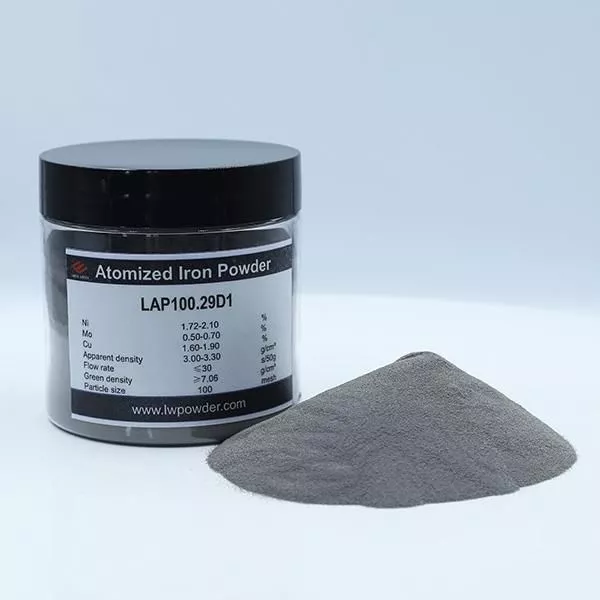
| LAP100.29D1 | Specification | 1.70-2.10 | 0.50-0.70 | 1.60-1.90 | ≤0.15 | Balance |
| LAP100.29D2 | Specification | 3.80-4.20 | 0.50-0.70 | 1.60-1.90 | ≤0.15 | Balance |
| LAP100.29D3 | Specification | 3.80-4.20 | 1.40-1.60 | 1.80-2.20 | ≤0.15 | Balance |
| LAP100.29D3 | Typical value | 3.90 | 1.51 | 1.90 | 0.10 | - |
| LAP100.29D4 | Specification | 1.4-1.6 | 0.50-0.70 | 1.80-2.20 | ≤0.15 | Balance |
| LAP100.29D4 | Typical value | 1.52 | 0.58 | 1.93 | 0.10 | - |
| LAP100.29D5 | Specification | 0.9-1.1 | 1.40-1.60 | 0.9-1.1 | ≤0.15 | Balance |
| LAP100.29D5 | Typical value | 1.03 | 1.49 | 1.05 | 0.10 | - |
| Grade | Basis | Apparent density g/cm³ | Flow rate s/50 g | Green density g/cm³ · test pressure | Rattler value % |
|---|---|---|---|---|---|
| LAP100.29D1 | Specification | 3.00-3.30 | ≤30 | ≥7.06 at 600 MPa | ≤1 |
| LAP100.29D2 | Specification | 3.00-3.30 | ≤30 | ≥7.06 at 600 MPa | ≤1 |
| LAP100.29D3 | Specification | 3.00-3.30 | ≤30 | ≥7.00 at 600 MPa | - |
| LAP100.29D3 | Typical value | 3.05 | 25.8 | 7.08 at 600 MPa | - |
| LAP100.29D4 | Specification | 3.00-3.30 | ≤30 | ≥7.00 at 600 MPa | - |
| LAP100.29D4 | Typical value | 3.05 | 25.8 | 7.10 at 600 MPa | - |
| LAP100.29D5 | Specification | 3.00-3.30 | ≤30 | ≥7.00 at 600 MPa | - |
| LAP100.29D5 | Typical value | 3.05 | 26.3 | 7.09 at 600 MPa | - |
| Grade | Basis | 180-200 μm | 150-180 μm | 106-150 μm | 75-106 μm | 45-150 μm | < 45 μm |
|---|---|---|---|---|---|---|---|
| LAP100.29D1 | Specification | ≤1 | ≤10 | - | - | Balance | 10 ~ 30 |
| LAP100.29D2 | Specification | ≤1 | ≤10 | - | - | Balance | 10 ~ 30 |
| LAP100.29D3 | Specification | ≤1 | ≤10 | Balance | Balance | Balance | 15—30 |
| LAP100.29D3 | Typical value | 0 | 2.5 | 21.2 | 25.9 | 30.1 | 20.3 |
| LAP100.29D4 | Specification | ≤1 | ≤10 | Balance | Balance | Balance | 15—30 |
| LAP100.29D4 | Typical value | 0 | 1.8 | 20.8 | 27.9 | 28.6 | 20.9 |
| LAP100.29D5 | Specification | ≤1 | ≤10 | Balance | Balance | Balance | 15—30 |
| LAP100.29D5 | Typical value | 0 | 3.7 | 28.7 | 27.4 | 24.0 | 16.2 |
The supplied specification labels one sieve fraction “45–150 μm”, which overlaps the “106–150 μm” and “75–106 μm” columns. The original labels and values are shown here; confirm the intended intervals when specifying this distribution. Typical values are examples, not specification limits.
Pre-alloying introduces alloy additions before atomization. Diffusion alloying starts from a selected base powder and adds a separate diffusion treatment.

Feed materials
Both feed materials enter the melting stage.
Follow the numbered sequence.
Possible downstream routes for this powder
Downstream processing is selected for the required product; it is not an additional step for every grade.

Alternative base powders
Select the base powder for the formulation; these are alternative starting routes.
Follow the numbered sequence.
Possible downstream routes for this powder
Downstream processing is selected for the required product; it is not an additional step for every grade.
Production sequence: catalogue, printed pages 12–15. Process steps are shown separately from product qualification and batch release. Actual batch results follow the COA.
Compare all eight production routesTechnical review can include alloying elements, impurities, particle-size distribution, powder behaviour, compaction basis and batch release evidence.

Send the current supplier grade or target specification. Purchasing and technical review use the same brief.
Add your contact details and requirements on the Contact page.
Product family: Alloyed Steel Powder
This product family will be included in your enquiry. You can refine the requirement there.
Share your requirement once, in one form.