Compare
- Total iron and controlled impurities
- Apparent density and flow
- Green density and rattler value
- Full particle-size distribution
 Luyin Powders
Request a Quote
A broad family of sponge iron powders for grade-level qualification. Seventeen referenced grades are organized by 80, 100, fine and coarse series, helping purchasing and technical teams compare apparent density, flow, compaction behaviour and particle profile on one controlled basis.
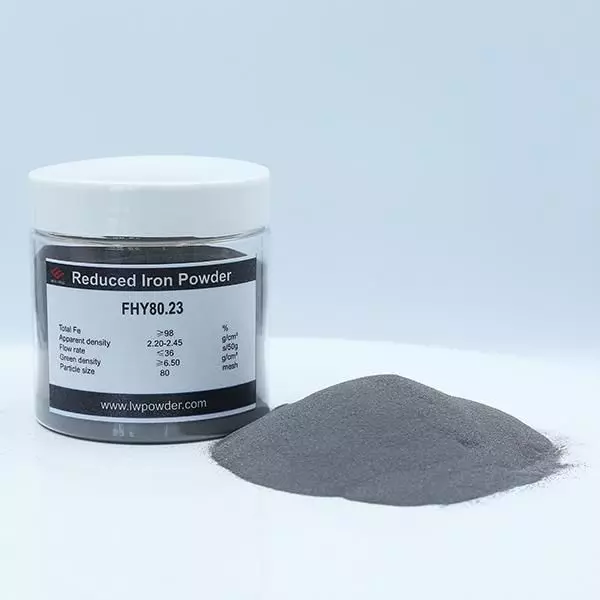
Confirm the available series, qualification documents, trial route and a comparable quotation basis.
Compare apparent density, flow, green density and particle profile. Application suitability is confirmed through technical review.
Application routes are discovery paths, not unverified grade claims. A grade is assigned only after the process, particle profile and controlled technical data are reviewed.
Seventeen grades are grouped by particle-size series. Compare chemistry, flow and density on the stated basis; all specified green densities use a compaction pressure of 490 MPa.
Product specification limits; actual batch results are provided in the shipment COA.
Chemistry and particle-size values are percentages. ≤ indicates a maximum; ≥ indicates a minimum. A dash or “Not stated” follows an unspecified source entry and does not mean zero. Select a grade to include it in your enquiry.
Scroll tables sideways to view all columns. The grade stays visible as you compare.
| Grade | C | Si | Mn | P | S |
|---|---|---|---|---|---|
| FHY80.23 | ≤0.05 | ≤0.15 | ≤0.40 | ≤0.020 | ≤0.030 |
| LRP80.22 | ≤0.10 | ≤0.30 | ≤0.70 | ≤0.040 | ≤0.060 |
| LRP80.23 | ≤0.10 | ≤0.30 | ≤0.70 | ≤0.040 | ≤0.060 |
| FHY80.25 | ≤0.03 | ≤0.15 | ≤0.40 | ≤0.020 | ≤0.030 |
| FHY80.27 | ≤0.03 | ≤0.15 | ≤0.40 | ≤0.020 | ≤0.030 |
| LRP80.25 | ≤0.10 | ≤0.30 | ≤0.70 | ≤0.040 | ≤0.060 |
| LRP80.27 | ≤0.10 | ≤0.30 | ≤0.70 | ≤0.040 | ≤0.060 |
| Grade | HL (hydrogen loss) | TFe |
|---|---|---|
| FHY80.23 | ≤0.40 | ≥98.00 |
| LRP80.22 | ≤0.80 | ≥97.00 |
| LRP80.23 | ≤0.80 | ≥97.00 |
| FHY80.25 | ≤0.40 | ≥98.00 |
| FHY80.27 | ≤0.40 | ≥98.00 |
| LRP80.25 | ≤0.80 | ≥97.00 |
| LRP80.27 | ≤0.80 | ≥97.00 |
| Grade | Apparent density g/cm³ | Flow rate s/50 g | Green density g/cm³ · test pressure | Rattler value % |
|---|---|---|---|---|
| FHY80.23 | 2.20-2.45 | ≤36 | ≥6.50 at 490 MPa | ≤1.2 |
| LRP80.22 | 1.95-2.25 | ≤50 | ≥6.25 at 490 MPa | ≤1.5 |
| LRP80.23 | 2.20-2.45 | ≤36 | ≥6.20 at 490 MPa | ≤1.5 |
| FHY80.25 | 2.45-2.65 | ≤34 | ≥6.55 at 490 MPa | ≤1.2 |
| FHY80.27 | 2.65-2.80 | ≤34 | ≥6.60 at 490 MPa | ≤1.2 |
| LRP80.25 | 2.45-2.65 | ≤34 | ≥6.25 at 490 MPa | ≤1.5 |
| LRP80.27 | 2.65-2.80 | ≤34 | ≥6.25 at 490 MPa | ≤1.5 |
| Grade | 180-200 μm | 150-180 μm | 106-150 μm | 75-106 μm | 45-75 μm | < 45 μm |
|---|---|---|---|---|---|---|
| FHY80.23 | ≤3 | Balance | 5 ~ 25 | |||
| LRP80.22 | ≤3 | Balance | 10 ~ 40 | |||
| LRP80.23 | ≤3 | Balance | 5 ~ 25 | |||
| FHY80.25 | ≤3 | Balance | 5 ~ 25 | |||
| FHY80.27 | ≤3 | Balance | 5 ~ 25 | |||
| LRP80.25 | ≤3 | Balance | 5 ~ 25 | |||
| LRP80.27 | ≤3 | Balance | 5 ~ 25 | |||
A cell spanning several particle-size columns is one combined fraction. “Balance” applies to that combined fraction.
| Grade | C | Si | Mn | P | S |
|---|---|---|---|---|---|
| FHY100.23 | ≤0.05 | ≤0.12 | ≤0.35 | ≤0.020 | ≤0.030 |
| FHY100.24 | ≤0.03 | ≤0.12 | ≤0.35 | ≤0.020 | ≤0.030 |
| FHY100.25 | ≤0.03 | ≤0.12 | ≤0.35 | ≤0.020 | ≤0.030 |
| FHY100.27 | ≤0.03 | ≤0.12 | ≤0.35 | ≤0.020 | ≤0.030 |
| Grade | HL (hydrogen loss) | TFe |
|---|---|---|
| FHY100.23 | ≤0.30 | ≥98.50 |
| FHY100.24 | ≤0.30 | ≥98.50 |
| FHY100.25 | ≤0.25 | ≥98.50 |
| FHY100.27 | ≤0.25 | ≥98.50 |
| Grade | Apparent density g/cm³ | Flow rate s/50 g | Green density g/cm³ · test pressure | Rattler value % |
|---|---|---|---|---|
| FHY100.23 | 2.20-2.35 | ≤40 | ≥6.60 at 490 MPa | ≤1.0 |
| FHY100.24 | 2.30-2.45 | ≤36 | ≥6.60 at 490 MPa | ≤1.0 |
| FHY100.25 | 2.45-2.65 | ≤34 | ≥6.60 at 490 MPa | ≤1.0 |
| FHY100.27 | 2.65-2.80 | ≤30 | ≥6.70 at 490 MPa | ≤1.0 |
| Grade | 180-200 μm | 150-180 μm | 106-150 μm | 75-106 μm | 45-75 μm | < 45 μm |
|---|---|---|---|---|---|---|
| FHY100.23 | 0 | ≤5 | Balance | 5 ~ 30 | ||
| FHY100.24 | 0 | ≤5 | Balance | 5 ~ 30 | ||
| FHY100.25 | 0 | ≤5 | Balance | 5 ~ 30 | ||
| FHY100.27 | 0 | ≤5 | Balance | 5 ~ 30 | ||
A cell spanning several particle-size columns is one combined fraction. “Balance” applies to that combined fraction.
| Grade | C | Si | Mn | P | S |
|---|---|---|---|---|---|
| LRP150 | ≤0.07 | ≤0.15 | ≤0.35 | ≤0.030 | ≤0.030 |
| FHY200 | ≤0.10 | ≤0.15 | ≤0.35 | ≤0.030 | ≤0.030 |
| LRP200(Ⅰ) | ≤0.15 | ≤0.25 | ≤0.50 | ≤0.050 | ≤0.050 |
| LRP200(Ⅱ) | ≤0.20 | ≤0.35 | ≤0.60 | ≤0.080 | ≤0.080 |
| LRP300 | ≤0.20 | ≤0.35 | ≤0.70 | ≤0.080 | ≤0.080 |
| Grade | HL (hydrogen loss) | TFe |
|---|---|---|
| LRP150 | ≤0.45 | ≥98.00 |
| FHY200 | ≤0.50 | ≥98.00 |
| LRP200(Ⅰ) | ≤0.70 | ≥97.00 |
| LRP200(Ⅱ) | ≤1.00 | ≥95.00 |
| LRP300 | ≤2.00 | ≥94.00 |
| Grade | Apparent density g/cm³ | Flow rate s/50 g | Green density g/cm³ · test pressure | Rattler value % |
|---|---|---|---|---|
| LRP150 | 2.40-2.70 | ≤35 | ≥6.60 at 490 MPa | - |
| FHY200 | 2.30-2.80 | - | - | - |
| LRP200(Ⅰ) | 2.00-2.80 | - | - | - |
| LRP200(Ⅱ) | 2.50-3.30 | - | - | - |
| LRP300 | 2.50-3.50 | - | - | - |
| Grade | 180-200 μm | 150-180 μm | 106-150 μm | 75-106 μm | 45-75 μm | < 45 μm |
|---|---|---|---|---|---|---|
| LRP150 | - | - | ≤5 | Balance | ≥30 | |
| FHY200 | - | 0 | ≤5 | Balance | ≥32 | |
| LRP200(Ⅰ) | - | 0 | ≤5 | Balance | ≥32 | |
| LRP200(Ⅱ) | - | 0 | ≤5 | Balance | ≥32 | |
| LRP300 | - | - | 0 | ≤5 | Balance | |
A cell spanning several particle-size columns is one combined fraction. “Balance” applies to that combined fraction.
| Grade | C | Si | Mn | P | S |
|---|---|---|---|---|---|
| FHT40.30 | ≤0.05 | ≤0.15 | ≤0.40 | ≤0.020 | ≤0.020 |
| Grade | HL (hydrogen loss) | TFe |
|---|---|---|
| FHT40.30 | ≤0.50 | ≥98.00 |
| Grade | Apparent density g/cm³ | Flow rate s/50 g | Green density g/cm³ · test pressure | Rattler value % |
|---|---|---|---|---|
| FHT40.30 | 2.90-3.10 | - | - | - |
| Grade | > 425 μm | 250-425 μm | 180-250 μm | 106-180 μm | < 106 μm | |
|---|---|---|---|---|---|---|
| FHT40.30 | ≤1 | 5 ~ 20 | Balance | Balance | ≤25 | |
A cell spanning several particle-size columns is one combined fraction. “Balance” applies to that combined fraction.
Iron scale and coke powder are prepared separately. The route then includes primary and secondary reduction, with the intermediate powder stages kept visible.

Feed materials
Prepare both feed materials separately, then bring them together at loading.
Follow the numbered sequence.
Production sequence: catalogue, printed pages 12–15. Process steps are shown separately from product qualification and batch release. Actual batch results follow the COA.
Compare all eight production routesTechnical review can include chemistry, particle-size distribution, apparent density, flow and application-specific compaction behaviour.
Send the current supplier grade or target data. Purchasing and technical review use the same brief.
Add your contact details and requirements on the Contact page.
Product family: Sponge / Reduced Iron Powder
This product family will be included in your enquiry. You can refine the requirement there.
Share your requirement once, in one form.