With final reduction
- Final reduction
- Grinding
- Screening
- Batch blending
- Finished powder
 Luyin Powders
Request a Quote
Compare nine pressed stainless steel grades and six metal injection molding grades by chemistry, particle profile and powder properties. Choose the forming route first, then use the specifications to prepare a grade-specific enquiry.

Compare grade specifications, identify the forming route and share trial quantity and delivery requirements.
Choose pressed PM or metal injection molding before comparing alloy and particle requirements. The specification tables separate the density measures and production conditions that matter to each process.
For a current-grade comparison, include your alloy standard, process conditions, technical data sheet and recent COA.
Compare 15 grades by composition and powder properties. Select a grade to include it in your enquiry.
Product specification limits; actual batch results are provided in the shipment COA.
Bal. / Bal / Balance means the balance of the stated composition or size distribution. “Not specified” marks an empty or unlisted field. A dash (-) is retained from the specification and does not mean zero.
Scroll tables sideways to view all columns. The grade stays visible as you compare.
Start with the alloy chemistry, then compare the sieve profile and powder behaviour for pressing and sintering. Apparent density describes loose powder, while the green-density specification below applies at 600 MPa; neither is the tap-density measure used for MIM.
| Grade | Cr | Ni | Mo | Cu | Nb | Fe |
|---|---|---|---|---|---|---|
| LS304 | 18.0-20.0 | 8.0-12.0 | - | - | Not specified | Bal |
| LS316 | 16.0-18.0 | 10.0-14.0 | 2.0-3.0 | - | Not specified | Bal |
| LS304L | 18.0-20.0 | 8.0-12.0 | - | - | Not specified | Bal |
| LS316L | 16.0-18.0 | 10.0-14.0 | 2.0-3.0 | - | Not specified | Bal |
| LS410L | 11.5-13.5 | - | - | - | Not specified | Bal |
| LS430L | 16.0-18.0 | - | - | - | Not specified | Bal |
| LS434L | 16.0-18.0 | - | 0.75-1.25 | - | Not specified | Bal |
| LS409L | 10.5-13.5 | - | ≤0.30 | Not specified | 0.3-0.8 | Bal |
| LS201 | 16.0-18.0 | 3.5-5.5 | Not specified | Not specified | Not specified | Bal |
| Grade | S | P | C | Si | Mn | O |
|---|---|---|---|---|---|---|
| LS304 | ≤0.03 | ≤0.04 | ≤0.08 | ≤1.0 | ≤2.0 | ≤0.4 |
| LS316 | ≤0.03 | ≤0.04 | ≤0.08 | ≤1.0 | ≤2.0 | ≤0.4 |
| LS304L | ≤0.03 | ≤0.04 | ≤0.03 | ≤1.0 | ≤2.0 | ≤0.4 |
| LS316L | ≤0.03 | ≤0.04 | ≤0.03 | ≤1.0 | ≤2.0 | ≤0.4 |
| LS410L | ≤0.03 | ≤0.04 | ≤0.03 | ≤1.0 | ≤1.0 | ≤0.4 |
| LS430L | ≤0.03 | ≤0.04 | ≤0.03 | ≤1.0 | ≤1.0 | ≤0.4 |
| LS434L | ≤0.03 | ≤0.04 | ≤0.03 | ≤1.0 | ≤1.0 | ≤0.4 |
| LS409L | ≤0.03 | ≤0.04 | ≤0.03 | ≤1.0 | ≤1.0 | ≤0.4 |
| LS201 | ≤0.03 | ≤0.06 | ≤0.15 | ≤0.75 | 5.5-8.0 | ≤0.4 |
| Grade | >150 μm (%) | 45–150 μm (%) | <45 μm (%) | Apparent density (g/cm³) | Green density at 600 MPa (g/cm³) | Flow rate (sec/50 g) |
|---|---|---|---|---|---|---|
| LS304 | ≤1% | Bal | ≤50% | 2.6-3.2 | 6.0-6.6 | 23-40 |
| LS316 | ≤1% | Bal | ≤50% | 2.6-3.2 | 6.0-6.6 | 23-40 |
| LS304L | ≤1% | Bal | ≤50% | 2.6-3.2 | 6.0-6.6 | 23-40 |
| LS316L | ≤1% | Bal | ≤50% | 2.6-3.2 | 6.0-6.6 | 23-40 |
| LS410L | ≤1% | Bal | ≤50% | 2.6-3.2 | 6.0-6.6 | 23-40 |
| LS430L | ≤1% | Bal | ≤50% | 2.6-3.2 | 6.0-6.6 | 23-40 |
| LS434L | ≤1% | Bal | ≤50% | 2.6-3.2 | 6.0-6.6 | 23-40 |
| LS409L | ≤1% | Bal | ≤50% | 2.6-3.2 | 6.0-6.6 | 23-40 |
| LS201 | ≤1% | Bal | ≤50% | 2.6-3.2 | 6.0-6.6 | 23-40 |
LS409L: the specification identifies Nb as 0.3–0.8%, although the original layout places it under the Cu heading. It is shown separately as niobium here; no copper value is specified. Nb values for other grades are not specified in this table.
Select the alloy and particle profile together with the intended feedstock, debinding and sintering process. These powders specify tap density and D50; the oxygen limits are different for water-atomized and gas-atomized powder and must be matched to the requested production route.
| Grade | Cr | Ni | Mo | Cu | Nb | Fe |
|---|---|---|---|---|---|---|
| LT304-J | 18.0-20.0 | 8.0-12.0 | - | - | - | Bal. |
| LT304L | 18.0-20.0 | 8.0-12.0 | - | - | - | Bal. |
| LT316L | 16.0-18.0 | 10.0-14.0 | 2.0-3.0 | - | - | Bal. |
| LT17-4PH | 15.5-17.5 | 3.0-5.0 | - | 3.0-5.0 | 0.15-0.45 | Bal. |
| LT440C | 16.0-18.0 | ≤0.5 | - | - | - | Bal. |
| LTFe-2Ni | - | 1.8-2.2 | - | Not specified | - | Bal. |
| Grade | C | Si | Mn |
|---|---|---|---|
| LT304-J | ≤0.08 | ≤1.0 | ≤2.0 |
| LT304L | ≤0.03 | ≤1.0 | ≤2.0 |
| LT316L | ≤0.03 | ≤1.0 | ≤2.0 |
| LT17-4PH | ≤0.07 | ≤1.0 | ≤1.0 |
| LT440C | 1.0-1.2 | 0.7-0.9 | ≤1.0 |
| LTFe-2Ni | 0.4-0.6 | ≤1.0 | ≤1.0 |
| Grade | Particle size (mesh) | Tap density (g/cm³) | D50 (μm) | Oxygen — water atomized (ppm) | Oxygen — gas atomized (ppm) |
|---|---|---|---|---|---|
| LT304-J | -300, -400, -500 | ≥4.5 | 8-12 | ≤4000 | ≤800 |
| LT304L | -500 | ≥4.5 | 8-12 | ≤4000 | ≤800 |
| LT316L | -500 | ≥4.5 | 8-12 | ≤4000 | ≤800 |
| LT17-4PH | -500 | ≥4.5 | 8-12 | ≤4000 | ≤800 |
| LT440C | -500 | ≥4.5 | 8-12 | ≤4000 | ≤800 |
| LTFe-2Ni | -500 | ≥4.5 | 8-12 | ≤4000 | ≤800 |
Water-atomized oxygen limit: ≤4000 ppm. Gas-atomized oxygen limit: ≤800 ppm. The Cu value for LTFe-2Ni is not specified in the source table.
The catalogue documents these three atomization routes. They are shown here for process comparison; the applicable route and finishing branch must be confirmed for the selected alloy and grade.

Feed materials
Follow the numbered sequence.

Feed materials
Follow the numbered sequence.
After drying: two alternative finishing paths
Use the applicable finishing path for the selected powder. The two paths are alternatives.

Feed materials
Follow the numbered sequence.
Production sequence: catalogue, printed pages 12–15. Process steps are shown separately from product qualification and batch release. Actual batch results follow the COA.
Compare all eight production routesUse the product specifications to compare grades and agree the acceptance requirements. The shipment COA provides actual batch results; process trials establish suitability for your pressing or MIM conditions.
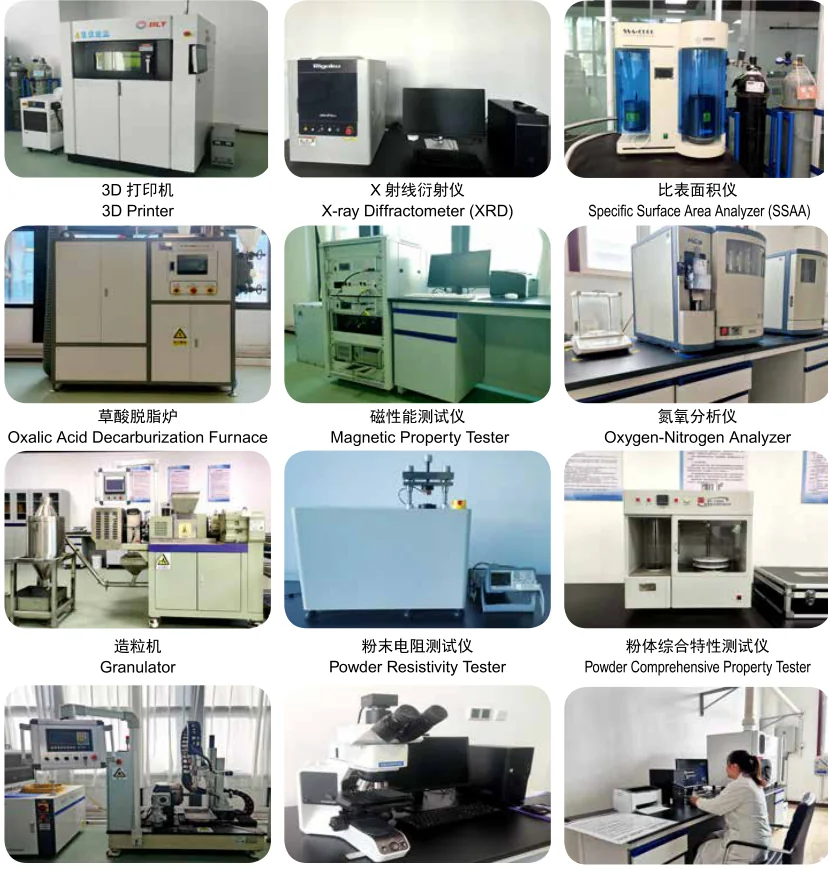
Select a listed grade or send your target specification, and identify pressed PM or MIM. Include trial quantity, process conditions and any acceptance requirements.
Add your contact details and requirements on the Contact page.
Product family: Stainless Steel / MIM Powder
This product family will be included in your enquiry. You can refine the requirement there.
Share your requirement once, in one form.